
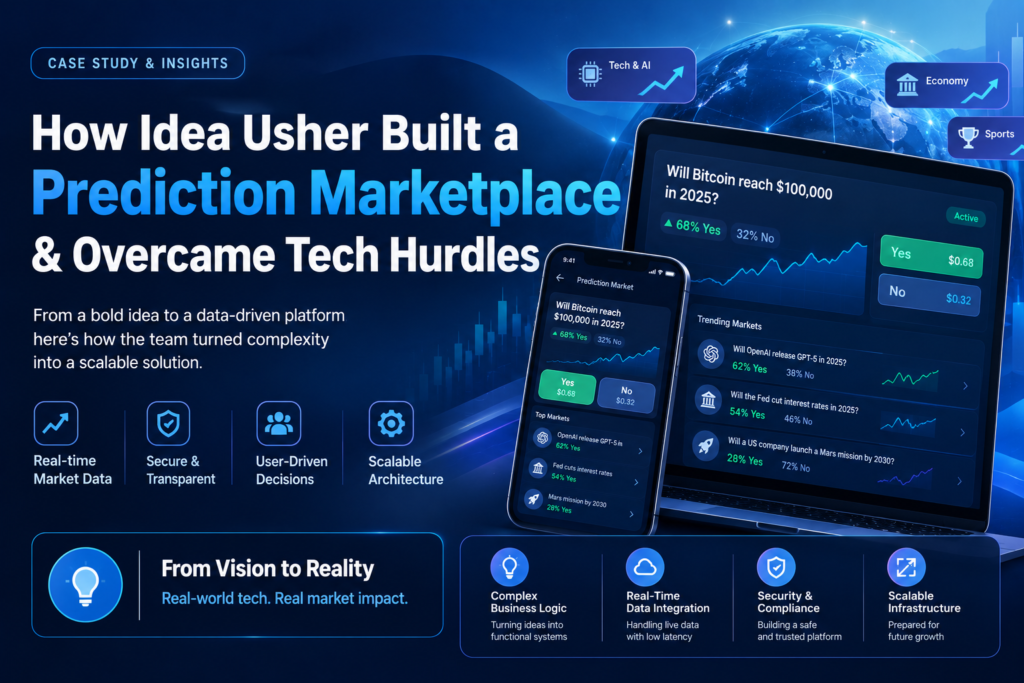
Building a prediction marketplace requires considerably more than creating an application where users can make predictions. Behind the interface is a complex technology ecosystem responsible for managing markets, processing event information, handling user activity, updating data, and maintaining a consistent experience across the platform.
Recognizing these challenges, Idea Usher approached prediction marketplace development as a complete software engineering project, focusing on the technical infrastructure required to support a reliable and scalable platform.
The development process involved addressing several challenges commonly faced by businesses entering the prediction marketplace space.
The Challenge: Turning a Prediction Concept Into a Functional Marketplace
One of the initial challenges was translating the prediction marketplace concept into a practical digital product.
A prediction platform needs clearly defined market structures, user workflows, event information, participation mechanisms, and market-resolution processes.
Simply developing a frontend would not solve these requirements.
Idea Usher approached the project by breaking the platform into different functional components, including the user application, marketplace engine, backend infrastructure, data integrations, transaction-related functionality, and administrative tools.
This created a foundation on which the different parts of the prediction marketplace could operate together.
Solving the Problem of Dynamic Market Management
Prediction markets are dynamic by nature.
Markets can open, remain active while an event is developing, and eventually close or become resolved. Managing these different states manually can become difficult as the number of markets increases.
Idea Usher addressed this requirement through marketplace logic designed around predefined market conditions.
The backend can manage market states and associated information while allowing administrators to control the marketplace through dedicated management functionality.
This approach reduces the need to manually coordinate every stage of a market’s lifecycle.
Solving the Real-Time Data Challenge
Another important consideration was event data.
Prediction marketplaces, particularly sports-focused platforms, depend on information such as fixtures, scores, statistics, and final outcomes.
If this information is not synchronized properly, the marketplace experience can quickly become outdated.
Idea Usher incorporated API-based data integration into the development approach, allowing relevant external information to be connected with the platform.
The integration layer can receive information from external sources and make the appropriate data available within the application.
This helps create a more responsive prediction marketplace environment.
Making the Platform Easier to Navigate
Another development challenge involved the user experience.
A prediction marketplace can contain large amounts of information. Users may need to browse events, understand available markets, review market information, manage their accounts, and monitor their activity.
Idea Usher focused on organizing these functions through intuitive interfaces and structured dashboards.
Market categories, event information, account details, notifications, and other important functions can be presented in a way that reduces unnecessary complexity for users.
Developing Administrative Controls
A prediction marketplace also needs an operational layer for administrators.
Rather than relying on developers to make every market-related change, administrators can use dedicated tools to manage platform information.
The development architecture can include administrative capabilities for managing users, markets, events, content, and other platform functions.
This gives the business greater visibility into the marketplace and simplifies routine management.
Addressing Security Requirements
Security was another consideration during development.
A prediction marketplace can handle user accounts, personal information, and transaction-related activity. This makes secure authentication, authorization, API protection, encrypted communication, and access controls important parts of the architecture.
Rather than treating security as a separate feature, these considerations can be incorporated throughout the application and backend.
Building With Future Expansion in Mind
Prediction marketplace businesses may eventually want to support additional event categories, more users, additional data providers, or new platform functionality.
For this reason, Idea Usher’s development approach focuses on creating a technology architecture that can be extended as requirements change.
Modular backend services, cloud infrastructure, API integrations, and scalable database architecture can provide the foundation for future improvements.
Idea Usher’s Role in Prediction Marketplace Development
Through its custom development capabilities, Idea Usher can help businesses move from a prediction marketplace concept to a functioning digital platform.
The development scope can include mobile applications, web interfaces, backend systems, market management functionality, APIs, data integrations, dashboards, notifications, and other components required by the product.
Businesses exploring this technology can learn more about Idea Usher’s P2P sports prediction app development services.
Conclusion
The development of a prediction marketplace involves solving multiple technical problems at the same time.
From dynamic market management and real-time data integration to user experience, administration, security, and scalability, every layer contributes to the final product.
Idea Usher’s approach focuses on bringing these components together into a customized prediction marketplace architecture designed around the specific requirements of the business.

